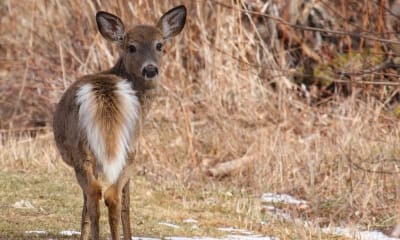
A common question we hear is, “what can I plant that the deer won’t eat?” The bad news is that there’s no such thing as a truly deer-proof plant: these animals, especially their young, are notorious for taste-testing. And if hungry enough, they’ll eat almost anything.
The good news is, there are a number of native plants that deer tend to avoid. If you live in a high-deer area, consider making plants from the below list a foundation for your landscape.
And remember – deer are part of the food web that backyard habitats aim to support! With a large-enough, mature native habitat, you can both provide resources to deer and preserve your garden from season to season. You may lose a few flowers from time to time, but you’ll be contributing to the ecosystem as a whole.
| # | Plant | Type | Sun | Moisture | Mature size | Deer resistance | Wildlife value |
|---|---|---|---|---|---|---|---|
| 1 | Oregon grape (Berberis aquifolium) | Shrub | Sun–shade | Dry–moderate | 3–10′ | ★★★★★ | Evergreen cover, berries, early flowers |
| 2 | Tall Oregon grape (Berberis nervosa) | Shrub | Part shade–shade | Moderate | 2–4′ | ★★★★★ | Evergreen cover, berries |
| 3 | Salal (Gaultheria shallon) | Shrub | Part shade–shade | Moderate | 3–6′ | ★★★★★ | Evergreen cover, berries, pollinators |
| 4 | Coyote brush (Baccharis pilularis) | Shrub | Full sun | Dry | 3–6′ | ★★★★★ | Excellent fall pollinator resource, cover |
| 5 | Blueblossom ceanothus (Ceanothus thyrsiflorus) | Shrub | Full sun | Dry | 6–15′ | ★★★★★ | Outstanding pollinator plant |
| 6 | Redstem ceanothus (Ceanothus sanguineus) | Shrub | Full sun | Dry | 3–8′ | ★★★★★ | Pollinators, nitrogen fixation |
| 7 | Oregon sunshine (Eriophyllum lanatum) | Perennial | Full sun | Dry | 1–2′ | ★★★★★ | Pollinators, long bloom |
| 8 | Sulfur buckwheat (Eriogonum umbellatum) | Perennial | Full sun | Dry | 1–2′ | ★★★★★ | Excellent pollinator plant |
| 9 | Yarrow (Achillea millefolium) | Perennial | Sun–part shade | Dry–moderate | 1–3′ | ★★★★ | Pollinators, beneficial insects |
| 10 | Douglas aster (Symphyotrichum subspicatum) | Perennial | Sun–part shade | Moderate–moist | 2–5′ | ★★★★ | Excellent late-season nectar |
| 11 | Showy fleabane (Erigeron speciosus) | Perennial | Sun–part shade | Dry–moderate | 1–3′ | ★★★★ | Pollinators |
| 12 | Western columbine (Aquilegia formosa) | Perennial | Part shade | Moderate | 1–3′ | ★★★★ | Hummingbirds, bees |
| 13 | Douglas iris (Iris douglasiana) | Perennial | Sun–part shade | Dry–moderate | 1–2′ | ★★★★ | Early-season pollinators |
| 14 | Blue-eyed grass (Sisyrinchium idahoense) | Perennial | Sun–part shade | Moderate | 6–18″ | ★★★★ | Pollinators |
| 15 | Broadleaf stonecrop (Sedum spathulifolium) | Perennial | Full sun | Dry | 4–8″ | ★★★★ | Bees and other small pollinators |
| 16 | Western blanketflower (Gaillardia aristata) | Perennial | Full sun | Dry | 1–2′ | ★★★★ | Bees and butterflies |
| 17 | Penstemon (Penstemon spp.) | Perennial | Full sun | Dry–moderate | 1–3′ | ★★★★ | Excellent hummingbird plant |
| 18 | Broadleaf lupine (Lupinus latifolius) | Perennial | Sun–part shade | Moderate | 2–4′ | ★★★★ | Native bees, butterflies |
| 19 | Vine maple (Acer circinatum) | Tree/shrub | Part shade–shade | Moderate–moist | 10–25′ | ★★★★ | Cover, seeds, nesting habitat |
| 20 | Pacific madrone (Arbutus menziesii) | Tree | Full sun | Dry | 20–50’+ | ★★★★ | Flowers, berries, wildlife cover |
| 21 | Oregon white oak (Quercus garryana) | Tree | Full sun | Dry–moderate | 30–80′ | ★★★★ | Exceptional biodiversity value |
| 22 | Incense cedar (Calocedrus decurrens) | Tree | Sun–part shade | Dry–moderate | 50–100’+ | ★★★★★ | Evergreen cover, nesting habitat |
| 23 | Ponderosa pine (Pinus ponderosa) | Tree | Full sun | Dry | 50–100’+ | ★★★★★ | Seeds, nesting, cover |
| 24 | Pacific serviceberry (Amelanchier alnifolia) | Shrub | Sun–part shade | Dry–moderate | 5–15′ | ★★★★ | Excellent berries for birds |
| 25 | Red-flowering currant (Ribes sanguineum) | Shrub | Sun–part shade | Dry–moderate | 6–12′ | ★★★★ | Exceptional hummingbird plant |
| 26 | Ninebark (Physocarpus capitatus) | Shrub | Sun–part shade | Moist | 8–15′ | ★★★★ | Cover, flowers, insects |
| 27 | Red elderberry (Sambucus racemosa) | Shrub | Sun–part shade | Moderate–moist | 10–20′ | ★★★★ | Berries, birds, pollinators |
| 28 | Western mock orange (Philadelphus lewisii) | Shrub | Sun–part shade | Dry–moderate | 6–12′ | ★★★★ | Fragrant flowers, pollinators |
| 29 | Tufted hairgrass (Deschampsia cespitosa) | Grass | Sun–part shade | Moist | 2–3′ | ★★★★ | Cover, seeds |
| 30 | Roemer’s fescue (Festuca roemeri) | Grass | Full sun | Dry | 1–2′ | ★★★★★ | Native meadow structure, seeds |