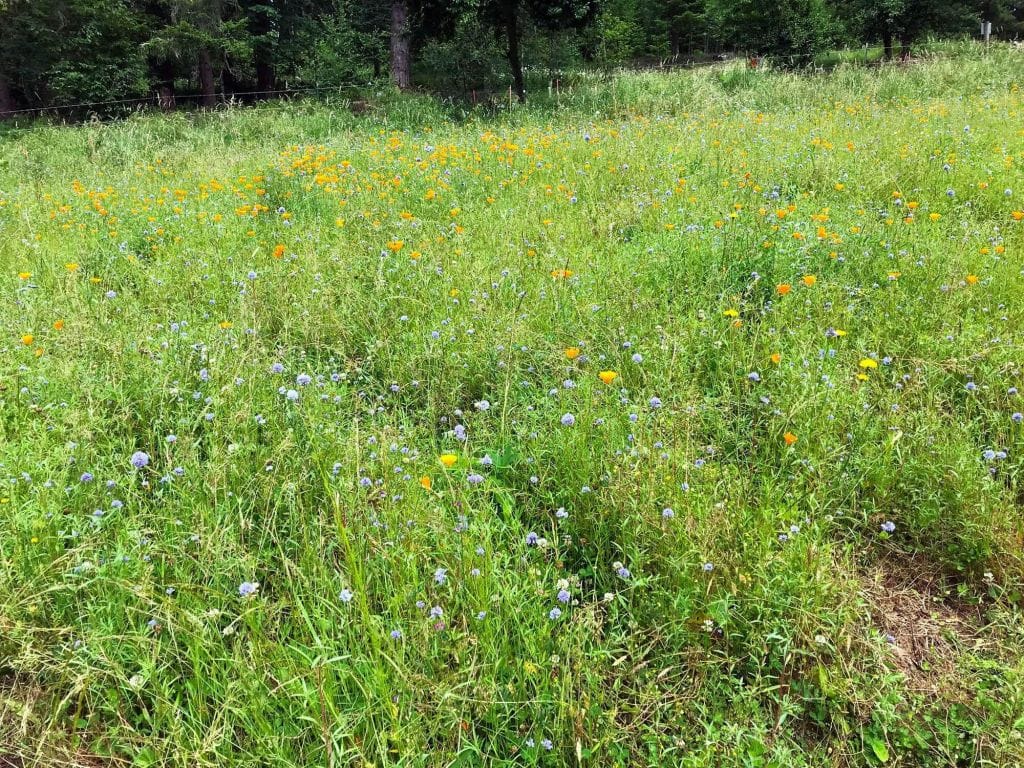
We know – that’s a big number. We set this requirement deliberately, based on the best available science, which shows that native plants aren’t optional for wildlife and environmental health – they’re essential. Current research indicates that to have true wildlife value, habitats should be at least 70% native. Here’s why:
MANY SPECIES CANNOT SURVIVE WITHOUT SPECIFIC NATIVE PLANTS.
This is especially true for insects, which form the base of the food web. Non-native ornamentals may look lush, but many are biological deserts, offering little or no food value. Most native insects are specialists, evolved to eat only certain native plants. Caterpillars—the primary food source for baby birds—often require one genus or even one species of plant.
DID YOU KNOW? A single brood of chickadees needs 6,000–9,000 caterpillars to raise their young!
Plant natives → insects return → birds, bats, amphibians, and mammals follow.
NATIVE PLANTS SUPPORT FAR MORE POLLINATORS THAN NON-NATIVE SPECIES.
Native plants produce nectar and pollen with the right chemistry for local bees, butterflies, moths, beetles, and flies. Many native bees are solitary and ground-nesting—they rely on native vegetation structure and undisturbed soils. Diverse pollinators mean more resilient food systems, from backyard gardens to regional agriculture. Replacing non-natives with natives directly combats pollinator decline.
NATIVE PLANTS PROTECT WATER – ABOVE AND BELOW GROUND.
Native plants are climate-adapted engineers. Their deep, fibrous root systems increase soil infiltration and reduce runoff. They filter pollutants before water reaches streams, rivers, and groundwater. Native vegetation reduces erosion, protecting waterways from sediment and nutrient overload. And as a bonus for you – landscapes with natives require less irrigation, conserving water during dry seasons.
NATIVE PLANTS BUILD SOIL HEALTH.
Native plants evolved alongside local soil microbes and fungi. Their roots feed mycorrhizal networks that improve nutrient exchange and carbon storage. Increased organic matter improves soil structure, reducing compaction and increasing drought resilience. Deeper roots lead to cooler soils, a healthier microbe community, and long-term resilience. In short, a turf lawn only skims the surface, while a mixed native ecosystem is a living sponge, water reservoir, and carbon bank.
DID YOU KNOW? A standard turf lawn’s roots only extend between 2-6 inches, while a native prairie averages a root depth of 3-10 feet!
NATIVE LANDSCAPES ARE MOST CLIMATE-RESILIENT.
Native plants are adapted to local rainfall patterns, seasonal temperature swings, and periodic flooding, drought, or fire. As climate extremes intensify, native plantings bounce back faster after stress, require fewer chemical inputs, and reduce maintenance costs over time. They are a future-proof investment!
NATIVE PLANTS ARE LOWER-MAINTENANCE IN THE LONG RUN.
More native species=fewer pests and less chemicals. Native ecosystems maintain natural predator–prey balance and attract beneficial insects, which control pests without pesticides. Reduced chemical use protects pollinators, pets, children, and water quality. Native plants don’t eliminate insects—they support the right ones.
DID YOU KNOW? The annual maintenance cost for a quarter acre of traditional turf lawn averages around $1500, while the same amount of native landscape costs an average of only $200-$500 per year.