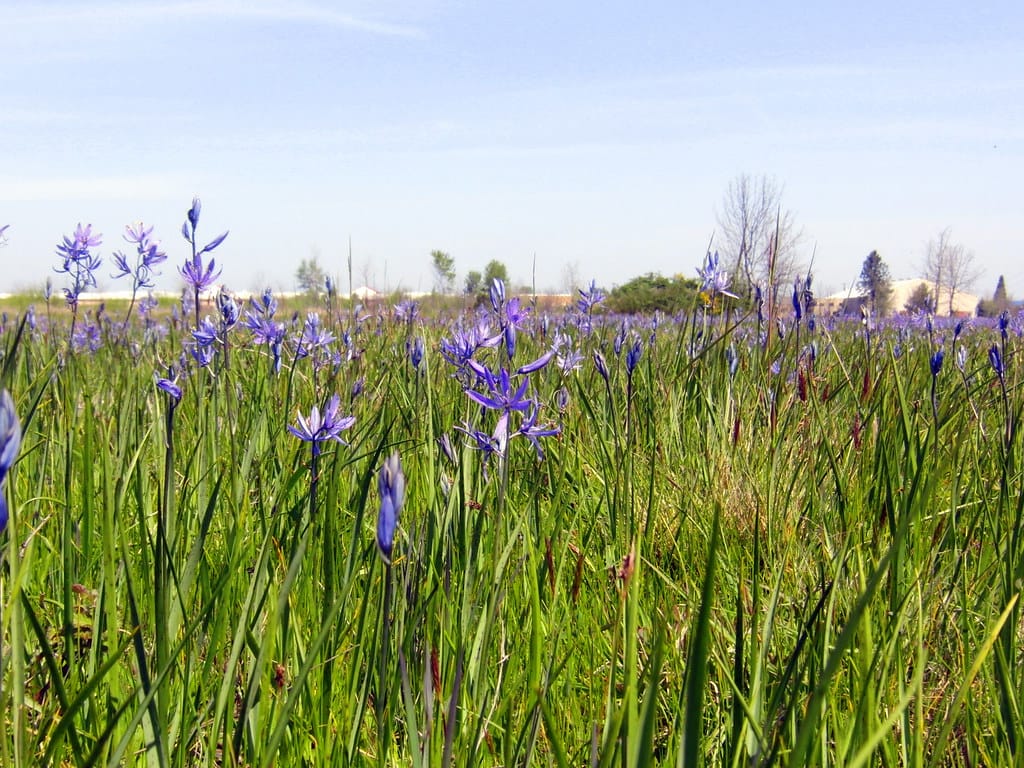
Native species and the habitats they comprise are in steep decline. Estimates indicate that oak woodlands and savannas have been reduced by 80%, wetlands by 87%, bottomland hardwood forests by 70%, and native prairie by over 98%. Overgrazing, residential and commercial development, mining, and other human activities have adversely impacted many native plant communities through habitat degradation or loss.
When native plants and habitats disappear, so does the wildlife that depends upon them. For example, 96% of birds rely on insects for their main food source, and 90% of insects rely on very specific native plants. Without the right plants, insects decline, birds decline, and on and on across the food web.
If half of American lawns were replaced with native plants, we would create the equivalent of a 20 million acre national park – nine times bigger than Yellowstone!” -Douglas Tallamy, Nature’s Best Hope
But there’s hope! Even a small native habitat can make a big difference for wildlife. By replacing lawn, weeds, or other low-value areas with native plants, you’re restoring food and shelter where none existed. And the more of us who restore native habitats, the more we can connected fragmented habitats and help offset habitat loss.
- Start by reviewing the Certification Requirements. Decide if you have the financial, physical, and time resources to accomplish the required conservation actions.
- Enroll as a habitat steward. You’ll pay a program fee at this time ($5 minimum) and officially become a program member.
- We’ll schedule a site visit at your property with one of our technicians to review program requirements, hear your goals and challenges, and share advice and guidance
- You’ll use the Resource Library to complete the required number of items for each of the 5 program areas. You can take as much time as you need, though we generally encourage people to complete their habitat project within 2 years of enrolling.
- You’ll request a final site visit from a technician to tour your habitat and review your checklist. Once completion is confirmed, you’ll receive your metal certification yard sign to display with pride!
If you own, rent, or manage any outdoor space in Benton County, this program is for you! We will work with you to develop a wildlife habitat at:
- Private homes
- Apartment residences
- Businesses and storefronts
- Non-profits and other community organizations
- Houses of worships
- Schools
- Public parks
- Probably any other type of space you can think of!
The Nature Neighbors certification requires that your habitat space be at least 50 square feet, and generally less than an acre. However, there’s no upper limit on property size, and the program is available for small urban lots, large rural properties, and everything in between!
Your designated habitat space can be spread out over several different areas, and can include containers, garden beds, planters, etc. As long as the total of all of the planted areas is more than 50 square feet, you’re good to go.
We don’t want to limit people, and encourage as much habitat area as possible! If you have a larger property to tackle, try starting with an acre or less close to your house. We hope the Nature Neighbors process will then help you to expand your habitat restoration practices beyond that first acre.
You are welcome here, and we’re here to help! Our team has put together an extension collection of resources, curated for our specific Certification Requirements, at our Resource Library. Your site technician will work with you to answer questions, plan your project, and connect you to resources throughout the process. We’re always available to answer questions and provide more resources as needed throughout your project.
We also have a Nature Neighbors Facebook Group where habitat stewards can share pictures, ask questions, and find inspiration. Hope to see you there!
We get it – creating habitat can be expensive! That’s why we offer enrollment fees on a sliding scale – you can determine how much you are able to pay, starting at just $5.
For those with significant financial burdens, we offer mini scholarships up to $500 to help habitat stewards purchase plants, tools, or whatever they need to create their habitat. Visit our Request Help page to apply for financial aid.
We want this program, and backyard conservation, to be accessible to ALL! If you find yourself struggling to complete your project, please reach out.
We know – that’s a big number (more than some other habitat certification programs require). We made this choice deliberately based on the best available current research, which shows that native plants aren’t optional for wildlife and environmental health – they’re essential.
Many wildlife species cannot survive without specific native plants.
This is especially true for insects, which form the base of the food web. Non-native ornamentals may look lush, but many are biological deserts, offering little or no food value. Most native insects are specialists, evolved to eat only certain native plants. Caterpillars—the primary food source for baby birds—often require one genus or even one species of plant.
Native plants support far more pollinators than non-native species.
Native plants produce nectar and pollen with the right chemistry for local bees, butterflies, moths, beetles, and flies. Many native bees are solitary and ground-nesting—they rely on native vegetation structure and undisturbed soils. Diverse pollinators mean more resilient food systems, from backyard gardens to regional agriculture. Replacing non-natives with natives directly combats pollinator decline.
Native Plants Protect Water—Above and Below Ground.
Native plants are climate-adapted engineers. Their deep, fibrous root systems increase soil infiltration and reduce runoff. They filter pollutants before water reaches streams, rivers, and groundwater. Native vegetation reduces erosion, protecting waterways from sediment and nutrient overload. And as a bonus for you – landscapes with natives require less irrigation, conserving water during dry seasons.
Native plants build soil health.
Native plants evolved alongside local soil microbes and fungi. Their roots feed mycorrhizal networks that improve nutrient exchange and carbon storage. Increased organic matter improves soil structure, reducing compaction and increasing drought resilience. Deeper roots lead to cooler soils, a healthier microbe community, and long-term resilience. In short, a turf lawn only skims the surface, while a mixed native ecosystem is a living sponge, water reservoir, and carbon bank.
Native Landscapes Are More Climate-Resilient.
Native plants are adapted to local rainfall patterns, seasonal temperature swings, and periodic flooding, drought, or fire. As climate extremes intensify, native plantings bounce back faster after stress, require fewer chemical inputs, and reduce maintenance costs over time. They are a future-proof investment!
Native plants are lower-maintenance in the long run.
More native species=fewer pests and less chemicals. Native ecosystems maintain natural predator–prey balance and attract beneficial insects, which control pests without pesticides. Reduced chemical use protects pollinators, pets, children, and water quality. Native plants don’t eliminate insects—they support the right ones.