NEED TO KNOW: In Benton County, if the rainwater capturing system does not exceed 5,000 gallons, does not require plumbing or drainage inside a building or structure, and rainwater is used only for non-potable uses such as irrigation, you do not need a plumbing permit.
Rain barrels, cisterns, or other rain capture devices take advantage of our abundant winter water, saving it for use during our dry summers. Rainwater is free, reducing your dependence on municipal water and lowering your water bill. It can also be better for plants, since rainwater is “softer” and free of chemicals and salts found in treated tap water.
Learn how to install a rain barrel below!
Materials You’ll Need
- Rain barrel (typically 40–80 gallons; food-grade or purpose-built)
- Downspout diverter or rainwater inlet screen
- Spigot or hose connection near bottom
- Overflow outlet (with hose or pipe)
- Level base (cinder blocks, pavers, or gravel)
- Optional: mesh screen (to block mosquitoes and debris), linking kit for multiple barrels
Installation Step-by-step
1. Choose a Location
- Find a spot under a downspout with easy access for your garden hose or watering can.
- Make sure it’s elevated and level—use blocks or bricks to raise the barrel (gravity increases water pressure).
2. Prepare the Downspout
- Cut the downspout a few inches above the top of the barrel.
- Attach a diverter kit or use a simple elbow to direct water into the barrel.
- Make sure excess water is routed away from your foundation (via overflow hose or diverter bypass).
3. Position the Barrel
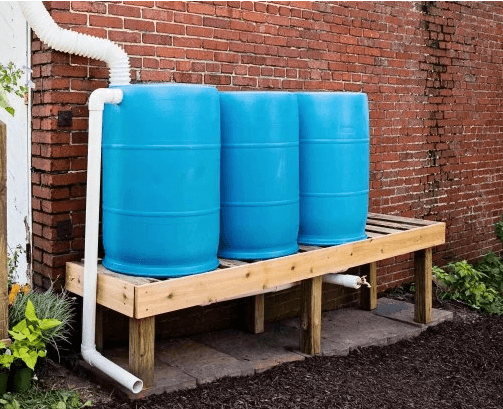
- Set it on your prepared base.
- Ensure the spigot is reachable and the barrel is stable.
- Attach screens or a sealed lid to keep out mosquitoes, leaves, and animals.
4. Connect Spigot and Overflow
- Install a spigot at the bottom for easy water access.
- Connect overflow outlet to a hose or pipe leading away from structures or into a second barrel.
5. Test the System
- Run water into the gutter or simulate rain with a hose to check flow into the barrel and make sure the overflow works properly.
Tips for Using Your Rain Barrel
- Use the water for vegetable gardens (non-edible parts), flowers, trees, lawns, and potted plants. Avoid using on edible parts unless filtered or treated
- Clean the barrel annually to prevent algae buildup.
- Disconnect and drain in winter if you’re in a freeze-prone area, or install a freeze-proof diverter.
- Use the water for vegetable gardens (non-edible parts), flowers, trees, lawns, and potted plants. Avoid using on edible parts unless filtered or treated
- Clean the barrel annually to prevent algae buildup.
- Disconnect and drain in winter if you’re in a freeze-prone area, or install a freeze-proof diverter.